Money Flows: The political consequences of migrant remittances. 2024. Oxford University Press.
2025 APSA Migration and Citizenship Best Book Award.
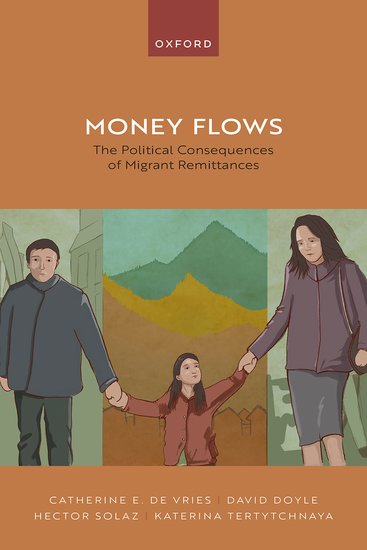
Money Flows studies how remittances shape the relationship between remittance recipients and the authorities in migrant-sending countries by providing a comprehensive study of the political effects of remittances on the attitudes of their recipients. It argues that far from being an exclusively economic risk-sharing mechanism between poorer, migrant-sending, and richer, migrant-receiving economies, remittances may compromise rudimentary accountability mechanisms in the developing world.
The book leverages survey data from Central-Eastern Europe, the Caucasus, and Central Asia and original focus groups from Kyrgyzstan. It shows how remittances, and fluctuations in their volume, colour recipients’ economic evaluations; shape the burden of corruption; and change how recipients interact with, and view their state, ultimately impacting the approval function of the authorities.
The Audiences of Repression: Protest Repression and Public Opinion in Putin’s Russia
Conventional academic wisdom holds that repression is more effective in preventing dissent when it is invisible and focuses on understanding how it affects the groups directly targeted. However, authoritarian governments often publicize their efforts to prevent dissent, even when repression fails to deter opposition. Expanding the understanding of the consequences of repression, this book develops and tests a theory of how legal repression aids autocracies. I argue that autocrats publicize legal repression in order to shape the public’s attitudes and behaviors and construct illegality in the service of political control. The audiences of repression, my argument suggests, are broader than conventionally assumed and involve not only the victims of repression but also public opinion at large.
Drawing on twelve years of unprecedented data from Russia (2012-2024) I provide comprehensive causal evidence of how publicized legal repression shapes society. The rich range of data the book relies on includes novel, detailed information on protest and protest permits, daily news stories, and original surveys of over 50,000 Russians with embedded survey experiments. Several of the opinion surveys the book relies on were fielded before and after Russia’s invasion of Ukraine and are presented for the first time in the manuscript. By showcasing how autocrats use legal repression to shape citizens’ views and behaviors, The Audiences of Repression reshapes our understanding of authoritarian control strategies and makes a vital contribution to the study of authoritarian politics and political violence. Written at a time of global democratic retrenchment and autocratic deepening, the book shows how the need to shape opinions influences how authoritarian governments rule and how, paradoxically, repression makes some societies more likely to permit the perpetuation of human rights abuses.
In dissertation form, this research was awarded the 2019 Arthur McDougall Prize for Best Dissertation for elections and representation by the Political Studies Association.
 Katerina Tertytchnaya